
Understanding NCAP Ratings: How Safe is Your Car on Indian Roads?
For decades, the primary question in the Indian car showroom was “Kitna deti hai?” (How much mileage does it give?). However, as we move through 2026, that question has been decisively replaced by “Safety rating kya hai?” According to recent market insights, safety has moved from a “luxury add-on” to a non-negotiable priority for Indian buyers. With the roads becoming faster and expressways expanding, understanding NCAP (New Car Assessment Program) ratings is no longer for enthusiasts—it’s a survival skill for every car owner.
The Shift: Global NCAP vs. Bharat NCAP
Until recently, Indian cars were mostly tested by Global NCAP under their “Safer Cars for India” campaign. However, the introduction of Bharat NCAP (BNCAP) has localized the standard.
While both programs use a 1-to-5 star rating system, BNCAP is tailored to the specific types of accidents common on Indian roads. A 5-star rating today is much harder to achieve than it was three years ago, as it now requires a combination of high-strength structural integrity and mandatory active safety features like Electronic Stability Control (ESC) and pedestrian protection.
Also Read: MG Majestor Launches in India on 20 April
Decoding the Star Rating: It’s More Than One Number
- AOP (Adult Occupant Protection): This measures how well the car protects the driver and front passenger during head-on and side impacts. It looks at critical areas like the head, neck, and chest.
- COP (Child Occupant Protection): This is often overlooked but arguably more important for families. It tests how well child restraint systems (ISOFIX) work during a crash and how much “whiplash” a child in the rear seat might experience.
Want to also sell your Bike? Contact Genie Bikez!
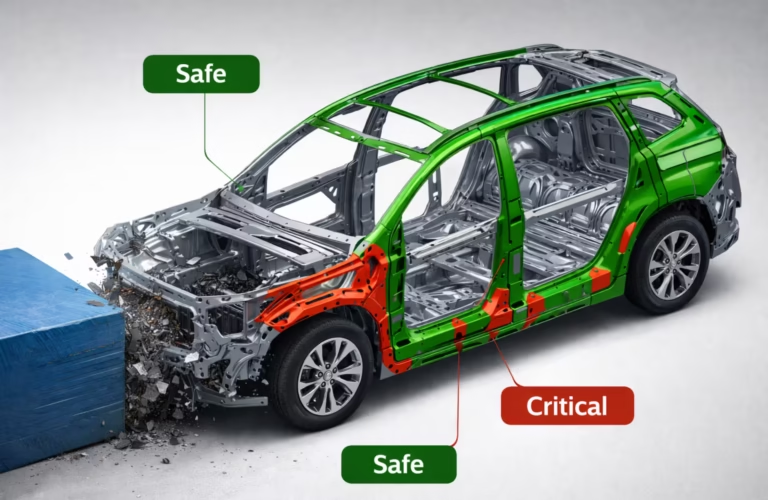
“Stable” vs. “Unstable” Structure: The Hidden Metric
A car can have 6 airbags and still receive a poor safety rating. Why? Because of the Body Shell Integrity.
- Stable Structure: The car’s frame can withstand further loadings beyond the test speed. Even after the crash, the doors can usually be opened normally, allowing for a quick exit.
- Unstable Structure: The frame collapses or deforms significantly. In these cases, even if the airbags deploy, the steering column or dashboard might move toward the occupants, causing severe injury.
Safety Priority Checklist for 2026:
- ISOFIX Mounts: Essential if you have a child seat.
- ESC (Electronic Stability Control): Now a mandatory requirement for high star ratings; it prevents skidding during sudden turns.
- Side Curtain Airbags: Crucial for protection during T-bone collisions at intersections.
- ADAS (Advanced Driver Assistance Systems): While not part of the core crash test, features like Automatic Emergency Braking (AEB) help avoid the crash entirely.
Safety as a High-Yield Investment
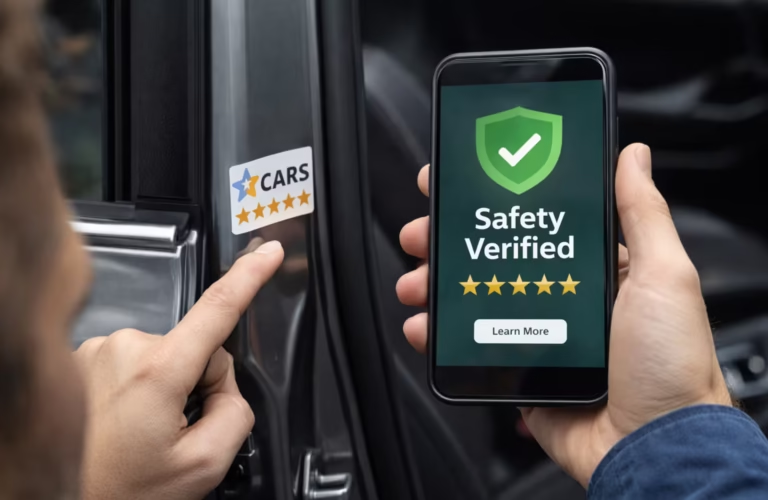
Beyond the obvious life-saving benefits, safety has a massive impact on your car’s financial future. In the current market, “zero-star” or “one-star” cars are becoming increasingly difficult to sell car online. Buyers are well-informed and are often willing to pay a premium of ₹50,000 to ₹1 lakh for a pre-owned vehicle with a proven safety record.
At Genie Bikez, we’ve observed that 5-star rated vehicles retain their value significantly better than their less-safe counterparts. When you eventually decide to sell car online, having a BNCAP or Global NCAP certificate in your digital file is a powerful trust-builder. It tells the next owner that the vehicle isn’t just a machine, but a protected environment.
The era of compromising safety for “extra features” or a “better music system” is over. In 2026, the safest car is the smartest investment you can make for your family and your wallet.
